
Jump to section
- Philosophy
- Statement on Conduct
- Conduct Authority
- Definition of Terms
- Student/Student Organization Rights
- Due Process
- Code of Conduct Violations
- Level I: Reprimand, Probation, Educational Sanctions, Community Service, Restitution, or Any Combination Thereof
- Level II: Any Level I Sanction, Facilities Suspension, Suspension, or Any Combination Thereof
- Level III: Any Level I or Level II Sanction, Expulsion, or Any Combination Thereof
- Notification Process for Code of Conduct Violations
- Code of Conduct Process
- Withdrawals during the Conduct Process
- Standards of Evidence
- Sanctions
- Interim Suspension
- Confidentiality and Protection from Retaliation
- Filing a False Report
- Student Conduct Hearing Procedures
- Report of Findings
- Presidential Appeals
Philosophy
Student conduct emphasizes a developmental approach toward discipline that is educational and proactive and allows for maximum student growth. Central Alabama Community College embraces the concept of a student-centered college committed to developing and establishing programs designed to enhance lifelong learning opportunities, foster a climate of personal growth and development, set high expectations for personal integrity, and assist students in the development of an informed set of values, ethics and beliefs. A student-centered college embraces a campus climate in which civility and respect among members of the campus community are viewed as vital to the overall ethical development of its students.
Statement on Conduct
Central Alabama Community College students are expected to obey national, state, and local laws; to respect the rights of members of the campus community, and to accept responsibility for the consequences of their behavior. In the event students fail to demonstrate such behavior, Central Alabama Community College reserves the right to take necessary and appropriate action to protect the safety and well-being of the campus community. This action may include pursuing disciplinary sanctions for violations of college rules, regulations, and policies as well as violations of national, state, and local laws. The College may take action for violations that occur on-campus and off campus, if the actions impact the College community, or on the Internet when those actions adversely affect the educational interest of the College. Any member of the College community may file charges against any student for violation of the Student Code of Conduct.
The Central Alabama Community College student conduct system is not a court of law. The Student Code of Conduct is not written with the specificity of a criminal statute. In cases where civil or criminal proceedings also involve a violation of the Student Code of Conduct, the College reserves the right to take appropriate disciplinary action against the student. This action will be regarded as separate and distinct from proceedings in criminal or civil court and may be scheduled according to timelines that serve the interest of the College.
Conduct Authority
The Dean of Students shall develop policies for the administration of the student conduct program and the procedural rules for the conduct of hearings that are not inconsistent with the provisions of the Student Code of Conduct. The Dean of Students, in consultation with the members of the President’s Cabinet, will determine the composition of the Student Conduct Committee.
The Dean of Students shall seek to ensure that the Student Conduct Committee is representative of the faculty and staff members who are willing and able to offer fair and thoughtful consideration of each case.
Central Alabama Community College (CACC) students are responsible for knowing the information, policies, and procedures outlined in the College Catalog & Student Handbook. CACC reserves the right to make changes to this code as deemed necessary, which become effective once those changes are posted online. Students are encouraged to check the college website for updated policies and procedures.
Definition of Terms
- The term "College" means Central Alabama Community College.
- The term "student" includes all persons taking courses at Central Alabama Community College either full-time or part-time. Persons who are not currently enrolled but who were previously enrolled would be considered to have a continuing relationship with the College so long as they are eligible to enroll. Individuals who are admitted but whose degree is not yet conferred are considered students.
- The term "faculty member" means any person employed by Central Alabama Community College to conduct classroom or teaching activities or who is otherwise considered by the College to be a member of the faculty.
- The term "college official" includes any person employed by Central Alabama Community College performing assigned administrative or professional responsibilities.
- The term “college premises” includes any property that is owned, controlled, used or leased by Central Alabama Community College.
- The term “college event” includes any activity conducted, sponsored, or authorized on behalf of Central Alabama Community College whether on or off college premises.
- The term "organization" means a student organization who has complied with the formal requirements for recognition.
- The term "Student Conduct Committee" refers to all persons designated by the Dean of Students to be responsible for the management of the student conduct program. The Committee members are authorized to investigate, adjudicate, or otherwise resolve any cases of alleged student misconduct.
- The term "policy" is defined as the written regulations of the College as found in, but not limited to, the Student Code of Conduct, the College Catalog & Student Handbook, and all official publications of the College whether in print or published on the Internet.
Student/Student Organization Rights
A student or student organization of Central Alabama Community College charged with a violation of the Student Code of Conduct has the following rights:
- Receive a written statement of the charges via CACC official e-mail account or certified postal mail to the address on file within five working days after the violation was reported.
- Receive a fair and impartial hearing.
- Know the nature of the evidence against them.
- Present evidence and witnesses in their own behalf.
- Be accompanied at a hearing by an advisor.
- Be present at the hearing during the presentation of any evidence or material on which a recommendation will be made. If a student/student organization fails to attend the hearing, it will be held in their absence.
- Refuse to answer questions.
- Receive a decision based solely on the evidence presented.
- Have a record made of the hearing.
- Receive a written notice of the decision and an explanation of the decision and sanctions.
- Appeal decisions.
Students or organizations may waive these rights by agreeing to administrative adjudication. No student is required to agree to administrative adjudication.
Due Process
Students at Central Alabama Community College are provided a copy of the Student Code of Conduct annually in the form of a link on the College website. Hard copies are available upon request from the Office of Student Services. Students are responsible for reading and abiding by the provisions of the Student Code of Conduct.
Code of Conduct Violations
The following list of violations of the Student Code of Conduct is an example of behaviors that may result in disciplinary action by the College. It is not to be regarded as all-inclusive. In the event that there arises ambiguity, inconsistency, or a need for further clarification regarding what constitutes a violation of the Student Conduct Code, the Dean of Students shall make the final determination. Any student or student organization found to be responsible for misconduct is subject to college sanctions.
Code of Conduct violations have been divided into various levels of severity and possible sanctions assigned based on this classification.
Level I: Reprimand, Probation, Educational Sanctions, Community Service, Restitution, or Any Combination Thereof
Level I violations include but are not limited to the following:
- Tobacco
- use of any tobacco product on college premises
- Gambling
- engaging in any form of gambling that is in violation of the law
- Pets
- possession of animals within campus buildings; service animals and medically approved emotional support animals are the only exception
- Solicitation and Sales
- solicitation and sales of any kind on campus without prior permission from the Dean of Students
- Skateboards, Hover Boards, and Roller Blades
- use of skate boards, hover boards, or roller blades on campus
Level II: Any Level I Sanction, Facilities Suspension, Suspension, or Any Combination Thereof
Level II violations include but are not limited to the following: repeat offenses of any Level I violations, and:
- Alcohol Possession and Use
- manufacturing, distributing, dispensing, possessing, or using alcoholic beverages on college premises
- manufacturing, distributing, dispensing, possessing, or using alcoholic beverages during a college event
- being in a state of alcohol intoxication on college premises or at a college event
- Damage or Destruction of Property
- any damage or destruction of college property or another person’s property on campus or at any event with which the College is affiliated
- Deception
- any misuse of college records, forms, or documents through forgery, unauthorized alteration, reproduction, or other means
- all forms of dishonesty including cheating and plagiarism
- any giving or receiving of false information to the College or to any college official, administrator, or administrative unit
- providing false information to law enforcement officials
- possession of any fake or altered or any other identification that belongs to another person
- any attempt to perpetrate a fraud against the College or a member of the College community
- Disorderly Conduct
- all lewd, obscene or indecent behavior or expression, or other forms of disorderly conduct
- use of profane language or verbal abuse toward any college employee or student
- any abuse or unauthorized use of sound amplification equipment
- any conduct which materially interferes with the normal operation of the College or with the requirements of appropriate discipline
- excessive noise determined to be disturbing to other residents or college officials
- Failure to Comply
- failing to respond to an official directive by properly identified college officials or law enforcement officials in the performance of their duties, including failure to display student ID
- failing to report for a conference, meeting, or appointment with any college official or faculty member
- failing to comply with any disciplinary condition imposed on a person by the Student Disciplinary Committee or any college official
- fleeing from law enforcement or college officials
- False Representation
- any unauthorized claim to speak and/or act in the name of Central Alabama Community College or any organization, student, college officials, or faculty members
- Fire Safety
- any failure to evacuate or immediately respond to a fire alarm
- participation in creating or causing a false fire alarm
- participation in tampering, disconnecting, or altering any fire alarm system, equipment, or component
- failure to follow the instructions of college official and emergency personnel during fire alarms
- the possession, use, manufacture, and/or sale of any incendiary device
- participation in setting or causing to be set any unauthorized fire
- the possession and/or use of any type of fireworks
- the possession or use of candles, incense, or other flame-emitting articles in the buildings
- Harassment
- the striking, shoving, kicking, or otherwise touching or making physical contact in regard to another for the purpose of harassing, annoying, or alarming
- directing abusive or obscene language or making an obscene gesture toward someone for the purpose of harassing, annoying, or alarming (i.e. making or using persistent derogatory comments, epithets, or slurs that place a person in a hostile or fearful environment or where the person’s safety is in jeopardy.)
- Unauthorized Use
- unauthorized use or possession of college equipment or property
- unauthorized use or duplication of any keys
- Unauthorized Use of Computer Resources
- use of a college owned computer when not currently enrolled in a class requiring the use of a college owned computer or without the written permission from the appropriate college official
- inspection and/or modification of data or programs that were not specifically assigned to, owned by, or created by the modifier
- use of another individual’s account number without permission
- interference, electronically or otherwise, with other users of college computers
- unauthorized use of computer resources for personal gain
- use of another individual’s programs or data without permission
- viewing, printing, or transmitting obscene, sexually suggestive, vulgar, or offensive messages on websites
- unnecessary use (waste) of computing supplies
- physical abuse of hardware
- harassment of any kind
- transmitting messages with derogatory or inflammatory remarks about an individual’s race, age, disability, religion, national origin, physical attributes, or sexual preference
- transmitting messages with abusive, profane, or offensive language
- using computer resources for any purpose that is illegal, against college policy, or contrary to the best interest of the College
- using computer resources to participate in Internet games, contests, or chat rooms or transmitting e-mail or other electronic communications that hides or misrepresents the identity of the sender
- violation of copyright(s): Copyrighted materials may not be transmitted by individuals using the College e-mail/Internet system. Users may not copy, retrieve, modify or forward copyrighted or licensed materials except with the owner’s permission or as a single copy for reference only
Level III: Any Level I or Level II Sanction, Expulsion, or Any Combination Thereof
Level III violations include but are not limited to the following: repeat offenses of any Level I or Level II violations, and,
- Assault*
- any intentional physical contact of an insulting or provoking nature
- any physical abuse, intentional injury, or physical harm of another person
- Disorderly/Improper Assembly
- any assembly for the purpose of causing a riot, destruction of property, or disorderly diversion which interferes with the normal operation of the College
- any obstruction to the free movement of other persons about campus or the interference with the use of College facilities
- Drug Possession and Use
- manufacturing, distributing, dispensing, possessing, or using controlled or illegal substances and/or drug paraphernalia on college premises
- manufacturing, distributing, dispensing, possessing, or using controlled or illegal substances and/or drug paraphernalia during a college event
- being in a state of drug intoxication on any college premises or at any college events
- Hazing
- any intentional, knowing, or reckless act committed by a person (whether individually or in concert with other persons) against another person or persons regardless of the willingness of such other person or persons to participate, that is committed in the course of an initiation into, an affiliation with, or the maintenance of membership in a students organization; and
- causes or creates a risk, above the reasonable risk encountered in the course of participation in the institution of higher education or the organization (such as the physical preparation necessary for participation in an athletic team), of physical or psychological injury including –
- whipping, beating, striking, electronic shocking, placing of a harmful substance on someone’s body, or similar activity;
- causing, coercing, or otherwise inducing sleep deprivation, exposure to the elements, confinement in a small space, extreme calisthenics, or other similar activity;
- causing, coercing, or otherwise inducing another person to consume food, liquid, alcohol, drugs, or other substances;
- causing, coercing, or otherwise inducing another person to perform sexual acts;
- any activity that places another person in reasonable fear of bodily harm through the use of threatening words or conduct;
- any activity against another person that includes a criminal violation of local, State, Tribal, or Federal law; and
- any activity that induces, causes, or requires another person to perform a duty or task that involves a criminal violation of local, State, Tribal, or Federal law.
- Sexual Assault*
- Having or attempting to have sexual intercourse with another individual by force or threat of force without effective consent; or where that individual is incapacitated or incapable of consenting
- Sexual Misconduct*
- Committing sexual abuse, sexual assault, sexual harassment, sexual exploitation, or statutory rape, as defined in the Code of Conduct or under Alabama state law
- Sexual Harassment *
- Conduct on the basis of sex that reflects one or more of the following:
- A school employee questioning education benefits on participating in unwelcome sexual conduct (i.e. quid pro quo);
- Unwelcomed conduct that a reasonable person would determine is so severe, pervasive, and objectively offensive that it effectively denies a person equal access to the school’s education program or activity; or
- Stalking, dating violence, or domestic violence
- Domestic or Intimate Partner Violence*
- any physical, sexual, or psychological harm against an individual by a current or former partner or spouse of a student
- willful intimidation, battery, or sexual assault committed by a family member, household member, domestic partner, or intimate partner
- Stalking*
- Stalking is a course of physical or verbal conduct directed at another individual that could cause a reasonable person to feel fear for her or his safety or the safety of others, or to suffer substantial emotional distress. Stalking may include, but is not limited to, pursuing or following a person in person or through electronic media (cyber-stalking); non-consensual (unwanted) communication by any means (i.e. letters, cards, photos, text messages, phone calls, e-mails, or other documentary or electronic communications); unwanted gifts; trespassing; and surveillance or other types of observation.
- Sexual abuse in the first degree*
- A person commits the crime of sexual abuse in the first degree if:
- He subjects another person to sexual contact by forcible compulsion; or
- He subjects another person to sexual contact who is incapable of consent by reason of being physically helpless or mentally incapacitated.
- Sexual abuse in the first degree is a Class C felony (Alabama Code 13A-6-66).
- A person commits the crime of sexual abuse in the first degree if:
- Sexual abuse in the second degree*
- A person commits the crime of sexual abuse in the second degree if:
- He subjects another person to sexual contact who is incapable of consent by reason of some factor other than being less than 16 years old; or
- He, being 19 years old or older, subjects another person to sexual contact who is less than 16 years old, but more than 12 years old.
- Sexual abuse in second degree is a Class A misdemeanor, except that if a person commits a second or subsequent offense of sexual abuse in the second degree within one year of another sexual offense, the offense is a Class C felony (Alabama Code 13A-6-67).
- A person commits the crime of sexual abuse in the second degree if:
- Rape in the first degree*
- A person commits the crime of rape in the first degree if:
- He or she engages in sexual intercourse with a member of the opposite sex by forcible compulsion; or
- He or she engages in sexual intercourse with a member of the opposite sex who is incapable of consent by reason of being physically helpless or mentally incapacitated; or
- He or she, being 16 years or older, engages in sexual intercourse with a member of the opposite sex who is less than 12 years old.
- Rape in the first degree is a Class A felony (Alabama Code 13A-6-61).
- A person commits the crime of rape in the first degree if:
- Rape in the second degree*
- A person commits the crime of rape in the second-degree if
- Being 16 years old or older, he or she engages in sexual intercourse with a member of the opposite sex less than 16 and more than 12 years old; provided, however, the actor is at least two years older than the member of the opposite sex.
- He or she engages in sexual intercourse with a member of the opposite sex who is incapable of consent by reason of being mentally defective.
- Rape in the second degree is a Class B felony (Alabama Code 13A-6-62).
- A person commits the crime of rape in the second-degree if
- Sodomy in the first degree*
- A person commits the crime of sodomy in the first degree if:
- He engages in deviate sexual intercourse with another person by forcible compulsion; o
- He engages in deviate sexual intercourse with a person who is incapable of consent by reason of being physically helpless or mentally incapacitated; or
- He, being 16 years old or older, engages in deviate sexual intercourse with a person who is less than 12 years old.
- Sodomy in the first degree is a Class A felony (Alabama Code 13A-6-63).
- A person commits the crime of sodomy in the first degree if:
- Sodomy in the second degree*
- A person commits the crime of sodomy in the second degree if:
- He, being 16 years old or older, engages in deviate sexual intercourse with another person less than 16 and more than 12 years old.
- He engages in deviate sexual intercourse with a person who is incapable of consent by reason of being mentally defective.
Sodomy in the second degree is a Class B felony (Alabama Code 13A-6-64).
Note: A third party may also file a violation of the Code of Conduct under this policy if the sexual conduct of others in the education or work environment has the purpose or effect of substantially interfering with the third party’s welfare or academic or work performance.
- A person commits the crime of sodomy in the second degree if:
- Theft
- taking, possessing, or attempting to sell or distribute any property that is the property of another person, organization, or entity (including but not limited to the College) without the owner's permission
- Unauthorized Entry
- unauthorized entry into any college building, office, parking lot, motor vehicle, or other facilities
- remaining in any college building after normal closing hours without proper authorization
- Weapons and Firearms
- keeping, using, possessing, displaying, or carrying any weapon, firearm, ammunition, fireworks, incendiary or any type of explosive device or material, or dangerous device capable of launching a projectile by air, gas, explosion, or mechanical means (including BB or pellet guns, air-soft guns, stun guns, and paintball guns) on the College premise unless specifically authorized by the administration or as part of a college-sanctioned event
- using, possessing, displaying, or carrying any toy weapon which resembles a real weapon, any swords, any illegal knives, any explosives (including fireworks and sparklers), any martial arts weapons, or any devices which are used to threaten the safety and well-being of a person on the college premise unless specifically authorized by the administration or as part of a college-sanctioned event
- using, possessing, or displaying dartboard, darts, or any type of throwing knives
- Violations of Law
- any act that violates a provision of the laws of the United States, the laws of any state in which such act occurs, the ordinances of any county, city, municipality, or other political subdivision, or the laws of another nation or political subdivision thereof in which such act occurs is deemed to be a violation of the Student Conduct Code when that act:
- occurs on any college premises
- occurs in the context of any college event
- occurs at any intercollegiate athletic event in which one of the College teams is participating, home or away
- involves more than one member of the College community
- otherwise adversely affects the College
- any act that violates a provision of the laws of the United States, the laws of any state in which such act occurs, the ordinances of any county, city, municipality, or other political subdivision, or the laws of another nation or political subdivision thereof in which such act occurs is deemed to be a violation of the Student Conduct Code when that act:
*Even in the absence of a Complaint under the Title IX Sexual Harassment Procedure the College reserves the right to pursue disciplinary sanctions for any act of sexual misconduct occurring on any of the College’s campuses, at any event with which the College is affiliated, or which negatively effects the employment or educational environment of a member of the college community.
Notification Process for Code of Conduct Violations
When a student is charged with a violation of the Student Code of Conduct, the student will be notified to appear for a meeting with the Dean of Students to respond to the charges. The notification will be sent either via certified mail to the address on file with the Office of Enrollment Services or will be e-mailed to the student’s official CACC e-mail.
Code of Conduct Process
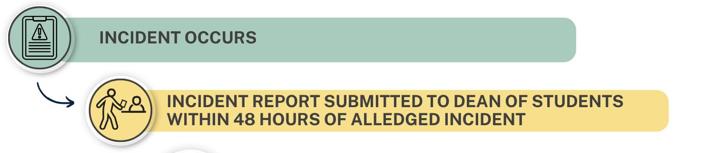
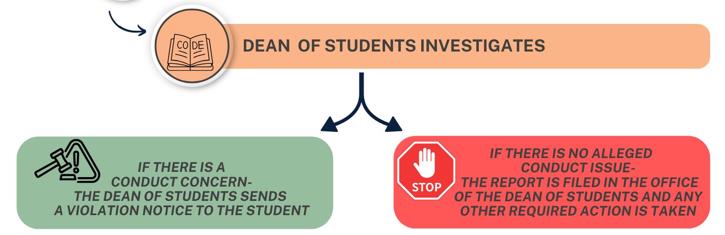
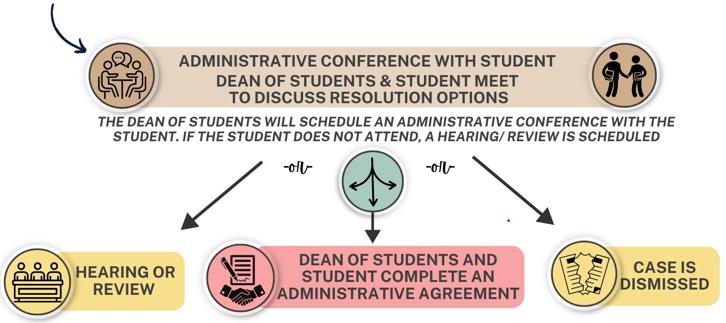

| Process / Action | Options & Outcomes |
|---|---|
| Incident Occurs & Report Submitted | An incident report must be submitted to the Dean of Students within 48 hours of the alleged incident. |
| Dean of Students Investigates | Option A: If there is no alleged conduct issue - the report is filed in the office of the Dean of Students and any other required action is taken. Option B: If there is a conduct concern - the Dean sends a Violation Notice to the student. |
| Administrative Conference with Student | If Option B, the Dean of Students and Student meet to discuss resolution options. Note: If the student does not attend, a Hearing/Review is automatically scheduled. |
| Determination of Outcome |
|
| Appeals Process | A student conduct appeals process may be initiated only if the case proceeded to a Hearing or Review. |
Withdrawals during the Conduct Process
A student’s withdrawal from the College does not absolve the student from student conduct responsibility. A student may be given the option to voluntarily withdraw from a class or from the College in lieu of disciplinary action. The Dean of Students or Student Conduct Committee, in some circumstances, may specify a period of time before the student may apply for readmission or reenroll in a class or classes. To qualify for readmission, the student must receive approval from the appropriate instructional dean and meet the academic standards for readmission. Students will not be eligible for any refund from the College. If a student withdraws before disciplinary procedures are carried out, the student will be subject to discipline as may be imposed by the designated college official at the time of reentry into the College.
Standards of Evidence
The evidentiary standard to be used by the Dean of Students, Student Conduct Committee, or the President is based strictly on the evidence presented whether it was more likely than not that the allegation(s) made against the accused student was (were) true based upon a reasonable belief of the Dean of Students, Student Conduct Committee, or the President.
The Committee Chairperson, will inform the parties that the rules relating to evidence will be similar to but less stringent than those which apply to civil trials in the courts of Alabama. Generally speaking, irrelevant, immaterial, and privileged information (such as personal medical information or attorney-client communications) shall be excluded. However, hearsay evidence and other types of evidence may be admitted if the Dean of Students or Committee Chairperson determines that the evidence offered is of the type and nature commonly relied upon or taken into consideration by a responsible, prudent person in conducting his/her affairs.
In the event of an objection by any party to any testimony or other information offered at the hearing, the Dean of Students or Committee Chairperson will have the authority to determine the admissibility of the testimony or other information, and this decision shall be final and binding.
Sanctions
A student or student organization found responsible for violating the Student Code Conduct, with the exception of violations related to academic dishonesty, may receive one or more of the sanctions listed below, as determined after a review of the findings. Code of Conduct violations have been divided into various levels of severity and possible sanctions assigned based on this classification.
Prior to issuing a sanction, it will be determined whether or not the accused student or student organization has any previous violations of the Student Code of Conduct. This may have an effect on the type and level of the sanction(s) to be imposed.
When a student organization engages in an act of misconduct, the College reserves the right to take action not only against the organization but also against the individual student members of the organization.
The following list of sanctions is intended to show the range of sanctions that may be imposed on a student or student organization, either individually or in combination. This list is not to be regarded as all-inclusive but rather as a sample of sanctions that may be imposed. Other College policies and regulations may impose specific penalties for specific violations and nothing in this section is intended to limit the imposition of those specific sanctions.
- Disciplinary Reprimand. This reprimand may be an oral or written warning. It notifies a student that any further violation of College regulations may subject the student to more severe disciplinary actions.
- Disciplinary Probation. This sanction is for a designated period of time, which may include exclusion from privileges, such as extracurricular activities and/or on-campus driving privileges. Furthermore, if the student is determined by any of the disciplinary procedures herein set out to be in subsequent violation of the Student Code of Conduct during the probationary period, the student may be either suspended or expelled. Provisions of the probationary period shall be determined and expressed by the Dean of Students or Disciplinary Committee.
- No Contact Orders. Written notice to cease all contact with an alleged victim of sexual misconduct is a no contact order.
- Cease and Desist Orders. Written notice to the alleged perpetrator to cease and desist any activity noted by the alleged victim as offensive or threatening and that may be a violation of the Sexual Misconduct Policy is a cease and desist order.
- Educational Sanction. An educational sanction may consist of the assignment of specific projects to be performed by a student or student organization, such as writing a research paper on a specific topic, performing community service hours, attending an educational program, and/or writing reaction papers on a specified topic.
- Community Service. Students may be assigned to complete a certain number of hours of community service work to improve their campus. Tasks will be assigned and completion of hours will be monitored be the Dean of Students or his/her designee.
- Fines and Restitution. Compensation for loss, damage, and injury may be imposed upon students for violations of the Student Code of Conduct or failure to complete community service. A hold on the student’s account may occur if fines and/or restitution is not paid.
- Loss of Privileges. Denial of specific privileges for a designated period of time.
- Payment of Damages. Charges will be assessed against students for the amount necessary to repair damage caused by their misconduct.
- Organizational Sanctions. Loss of privileges, including College recognition, for a specific period of time or permanently. Loss of privileges may include, but is not limited to, a prohibition on social events or fund-raising projects. In addition, the completion of community service hours and special projects may be required.
- Disciplinary Suspension. This suspension excludes a student from the College for a designated period of time, usually not more than two terms. While on suspension, a student will not be allowed to take any courses at the College. At the end of the designated period of time, the student must make formal reapplication for admission and meet all reasonable requirements and academic standards for readmission. Students will not be eligible for a refund from the College. If suspension is imposed when there are less than 30 days in the academic term, the suspension will carry over into the next semester of enrollment.
- Voluntary Withdrawal. A student may be given the option to voluntarily withdraw from a class or from the College in lieu of disciplinary action. The Title IX Coordinator may specify a period of time before the student may apply for readmission or reenroll in a class or classes. To qualify for readmission, the student must receive approval from the instructional dean and meet the academic standards for readmission. Students will not be eligible for any refund from the College. (If a student withdraws before disciplinary procedures are carried out, the student will be subject to discipline as may be imposed by the designated College official at the time of reentry into the College).
- Facility Suspension. A student may be suspended from using various campus facilities for misconduct in those facilities.
- Disciplinary Expulsion. This sanction is the strongest disciplinary action. This category of severe penalty generally indicates the recipient may not return to the College. Disciplinary expulsion normally would be the least-used disciplinary action and would be applied only to students who are responsible for chronic misbehavior or a major misconduct. The College reserves the right, but has no duty, to lift prohibition against reenrollment if the student submits a written application for readmission showing that he/she has demonstrated an ability and readiness to comply with all College rules and regulations. The College will not consider such a request until at least two years from the date of expulsion.
- Counseling/Substance Abuse Counseling. Central Alabama Community College (CACC) partners with UWill to provide mental health counseling. In addition, referrals may be made to off-campus professional services. CACC can also provide a list of off-campus counseling resources to faculty, staff, and students for counseling services as well as resources for substance abuse. CACC is not responsible for the cost of professional counseling for students. This information is provided only to assist students and is not intended as an endorsement of a particular resource.
Interim Suspension
In certain circumstances, the Dean of Students may impose a college suspension prior to a hearing. Interim suspension may be imposed only:
- to ensure the safety and well-being of members of the College community or preservation of College property;
- to ensure the student’s own physical or emotional safety and well-being;
- if a student poses a threat to themselves or others;
- if a student poses a threat of disruption of or interference with the normal operations of the College.
During an interim suspension, students may be denied access to the campus (including classes) and/or all other college activities or privileges for which the student might otherwise be eligible. The student will be responsible for working with faculty members to make-up any missed work (if possible). If an interim suspension is imposed, the hearing should follow within three (3) business days. The student must be notified in writing through official CACC e-mail, certified mail to the address on file, and/or personal service.
Confidentiality and Protection from Retaliation
Every effort possible shall be made to ensure confidentiality of information received as a part of an investigation. Complaints will be handled on a “need to know” basis with a view toward protecting the interest of all parties involved. The College will do everything consistent with
enforcement of this policy and with the law to protect the privacy of all parties involved and to ensure that all involved are treated fairly.
A student bringing a complaint or assisting in the investigation of a complaint will not be adversely affected as a result of being involved in said complaint. Any act of reprisal, including interference, coercion, or restraint by a student, employee, or anyone acting on behalf of the College violates this policy and will result in appropriate disciplinary action.
Filing a False Report
It is a violation of college policies for any student, faculty or staff member, or administrator to file a false report against another individual.
Student Conduct Hearing Procedures
The Student Conduct Committee will be composed of faculty members (one of whom serves as chairperson) and non-faculty members. The Chairperson of the Committee will be the administrative officer of the Committee. The Chairperson’s duties include:
- coordinating the times and place for the hearings with the Office of the Dean of Students;
- informing committee members of the times and places of committee meetings and hearings;
- ensuring a quorum of committee members are present at the hearing;
- coordinating communication to the student and witnesses with Office of the Dean of Students;
- maintaining of committee and hearing records, which will be kept on file in the Office of the Dean of Students, and informing, in writing, the appropriate person(s) of the decision of the Committee.
The Student Conduct Committee Chairperson will notify the student of the time, place, and subject matter of the hearing at least seventy-two (72) business hours prior to the scheduled beginning of the hearing. The hearing will be conducted in a fair and impartial manner and disciplinary hearings will not be open to the public.
Members of the Committee may at any time disqualify themselves from consideration of any given case or cases because of personal bias or a conflict of interest.
Either party to the hearing may request of a chairperson that any member or members of the Committee be excluded from consideration of the case. Such a request must be for cause and brought to the Chairperson’s attention as the first step in the hearing. In the event a member is disqualified by a majority vote of the Committee from consideration of the case, the President shall appoint a replacement. The replacement must meet the general requirement of regular committee members.
- Hearings will be held in a private, confidential area.
- Witnesses will be present only when providing information to the Committee.
- The Committee shall not have the power to require sworn testimony of witnesses. A witness may decline to make an oral or written statement. An accused student has the right to remain silent, and such silence shall not be used against him/her.
- All procedural questions are subject to the final decision of the Committee chairperson.
- In the event a Complainant or Respondent (accused student) fails to attend a formal hearing after notification of the designated date, hour, and location, he/she waives the right to appear before the Committee. The hearing will be held and the Committee’s determination shall be based on the evidence and information presented. If the Complainant or the Respondent is unable to attend the hearing for good cause, he/she shall make a written request stating the reason for delay at least 48 business hours prior to the designated date. This request shall be directed to the Chairperson of the Committee. If approved by the Chairperson, a new date shall be established and appropriate notification will be provided to all parties involved. If the Chairperson does not approve the request, the student shall be notified of the Chairperson’s decision to continue the hearing as scheduled. Only one extension shall be granted. If the Complainant or the accused student fails to appear, the student forfeits the right to present his/her case and the Committee may proceed with the hearing.
At the hearing, the Committee Chairperson will read the Student Code of Conduct Charges filed against the student and provide a copy of the Incident Report to the student and the Committee members. After the incident report and Code of Conduct charges are read into the record, the Complainant will have the opportunity to present oral information and offer other supporting information as he/she deems appropriate to his/her claim of the violation of the Code of Conduct. The Respondent (student against whom the violation of the Code of Conduct was filed) will then be given the opportunity to present oral information and offer other supporting information as he/she deems appropriate to the his/her defense against the charges.
Any party to a Student Disciplinary Hearing will have the right to retain, at the respective party’s cost, the assistance of legal counsel or other personal representative. However, the respective attorney or personal representative, if any, will act in an advisory role only and will not be allowed to address the hearing body or question any witnesses. The College must be given a minimum of 48 hours’ notice if the Respondent is being assisted by an attorney or personal representative. The names of the personal representative or attorney must be submitted 48 hours prior to the hearing to the Dean of Students. The Dean of Students or Student Code of Conduct Committee members will not use an attorney unless the Respondent is also assisted by an attorney or other personal representative. The hearing will be recorded by an electronic recording medium. In addition, all supporting documents or information offered by the parties, whether admitted or not, will be marked and preserved as part of the hearing record.
The Committee Chairperson will make the participants aware that the rules relating to the admissibility of statements and information during the hearing will be less stringent than those which apply to civil trials. Generally speaking, irrelevant, immaterial and privileged information (such as personal medical information or attorney-client communications) will be excludable. However, hearsay conversations and unauthenticated documentary information may be allowed if the Committee Chairperson determines that the information offered is of the type and nature commonly relied upon or taken into consideration by a reasonably prudent person in conducting his affairs.
In the event of an objection by any party to any statement, information or documentation offered at the hearing, the Committee Chairperson will have authority to make a final ruling on the objection.
Report of Findings
Within five (5) working days following the hearing, there will be a written report given to the Dean of Students (with a copy to the President, the Complainant and each Respondent) of the findings of the Chairperson of the hearing committee, and the report will contain at least the following:
- Date and place of the hearing;
- The name of the hearing officer or each member of the hearing committee, as applicable;
- A list of all witnesses for all parties;
- Findings of fact relevant to the violation of the Student Code of Conduct;
- Regulations or policies relevant to the violation, and
- Recommendation(s) arising from the violation of the Student Code of Conduct and the hearing.
In the event of a finding by the Student Conduct Committee that the violation of the Student Code of Conduct was unfounded or was not supported by the evidence presented, the Dean of Students will notify the Complainant of any appeal that may be available to the Complainant. In the event of a finding that the Violation of the Code of Conduct was supported, in whole or in part, by the information presented, the Dean of Students will advise the Respondent of any available appeal.
Presidential Appeals
The Complainant and Respondent will have the right to appeal the decision of the Student Conduct Committee to the President of Central Alabama Community College, provided that:
- A notice of appeal is filed with the Dean of Students and the President within fifteen (15) calendar days following the receipt of the Committee report and
- The notice of appeal contains clear and specific objection(s) to the finding(s), and conclusion(s) and/or recommendation(s) of the hearing officer or committee. If the appeal is not filed by the close of business on the fifteenth (15th) day following the receipt of the Committee report, the right to appeal to the President will have been waived. If the appeal does not contain clear and specific objections to the hearing report, it will be denied by the President.
- President’s Review: If an appeal is accepted by the President, the President will have thirty (30) calendar days from his/her receipt of the notice of appeal to review and investigate the allegations contained in the incident report, to review the hearing record, to hold a hearing (if deemed appropriate by the President) and to produce a report of the President’s findings. The President will have the authority to (1) affirm, (2) reverse or (3) affirm in part and reverse in part and/or modify the findings, conclusions and recommendations arising from the student disciplinary hearing. The President’s report will be served to the Complainant and Respondent(s) by personal service or by certified mail, return receipt requested, at their respective home addresses on file.
If, after exhausting all available institutional processes, a student’s complaint remains unresolved, the student may appeal to the Alabama Community College System using the System’s official Student Complaint Form. Please refer to the ACCS Student Complaint Process found on the ACCS website. (https://www.accs.edu/student-complaints/)